
New homes, bonus rooms and ranch shops north of Frisco
Spray Foam Insulation in Prosper, TX
Cooler upstairs rooms and attics that stop fighting your AC, with each option priced in writing.
- Free in-home estimates
- Written quotes with foam type, inches and R-value per area
- Attic equipment and duct leaks checked before we insulate
Why New Prosper Homes Still Run Hot
Spray foam insulation in Prosper usually starts with a simple complaint: the upstairs will not cool down. Prosper grew from 2,097 people in 2000 to 30,174 in 2020, and most of its houses are recent two-story builds with the HVAC equipment and ductwork up in the attic. Nearby Frisco's climate summary on Wikipedia lists July highs around 96F, about 230 sunny days and roughly 39 inches of precipitation a year. On a summer afternoon that attic can run far above the outdoor temperature, and the cooled air in those ducts has to travel through it. We insulate and air seal those attics, along with walls, bonus rooms, garages, shops and barns, using open-cell or closed-cell foam where it pays and blown-in where it does the job for less.
Cold snaps are part of the picture
North Texas winters are short, but they are not always mild. Denton, just west, recorded a low of -6F on February 16, 2021, during the winter storm that knocked out power across the state. A house that is well sealed holds its heat longer when the power is out and keeps pipes in exterior walls and attics from freezing as quickly. The same sealing that helps in August helps in February.
The code your house was built to
Collin and Denton counties are both in Climate Zone 3A on the county list kept by OpenEI. Texas's statewide minimum for houses has been the 2015 IRC, Chapter 11, since September 1, 2016, which lists R-38 ceilings for Zone 3. The Town of Prosper went further: its building department says all permits applied for on or after May 1, 2023 must comply with the 2021 International Codes. The 2021 IECC base table, as summarized by the Department of Energy's Building America Solution Center, raised the Zone 3 ceiling requirement to R-49 and kept walls at R-20, R-13 plus R-5 continuous, or R-15 continuous. So a Prosper house permitted in 2018 and one permitted in 2024 may have been built to different attic targets, and we check what yours actually has.
Where the comfort problems come from
In new two-story homes we keep finding the same things. Attic kneewalls around bonus rooms with batts that have fallen away from the drywall, or no air barrier behind them. Duct boots that were never sealed to the ceiling. Chases around flues and plumbing left open to the attic. Blown-in that is thin near the eaves and around the air handler platform where trades walked. Bonus rooms built over a garage with gaps in the floor insulation. None of that shows up on a builder's spec sheet, but it shows up on the thermostat.
Closed cell vs open cell
Open-cell foam is light and soft. HomeGuide rates it at roughly R-3.5 to R-3.7 per inch. It expands to fill rafter bays completely, stops air movement and costs less per inch, so it is the usual choice for the roof deck when we convert an attic to a sealed, semi-conditioned space. Closed-cell foam is rigid and dense, about R-5 to R-7 per inch per HomeGuide, and at normal thickness it acts as a vapor retarder. Around Prosper we use it on garage ceilings under bonus rooms where depth is limited, on metal shops and barns, on rim areas and in spots too tight for enough open-cell. Each line of the quote names the foam and why.
Sealed attic or a better attic floor
There are two honest ways to fix a hot attic. One is to convert it: spray foam under the roof deck and on the gable walls, close the attic vents, and bring the HVAC equipment and ducts inside the insulated shell. The other is to keep the vented attic and fix the floor: seal every leak and duct boot, then blow insulation to a deeper, even depth. Conversion costs more and helps most when there is a lot of equipment up there. A better attic floor costs less and works well when the ducts are short or already tight. We price both when both make sense.
Spray foam insulation cost
HomeGuide's 2026 guide lists installed spray foam at $1.50 to $5.00 per square foot, with open-cell at $1.50 to $3.50 and closed-cell at $3.00 to $5.00, a spray foam attic at $3,000 to $8,000, and a whole house at $8,000 to $20,000. It notes that many crews set a job minimum of $1,000 to $2,000 or more. Fixr's 2025 guide shows $3.15 to $7.50 per square foot for existing walls and $2.75 to $6.50 for new construction. HomeGuide puts blown-in at $1.00 to $2.80 per square foot. Larger Prosper homes have big roof areas, often with several hip sections and dormers, so roof deck foam lands higher than in a simple ranch. These are national ranges for planning; the number on your written estimate is the one you pay.
Comparing insulation contractors and spray foam companies
There is no shortage of spray foam insulation contractors and insulation companies working the north Dallas suburbs, and quotes can be hard to compare. Ask each one which foam goes on which surface and how many inches. Ask what R-value that reaches. Ask how they handle the attic vents, the gas appliance combustion air and the HVAC system when they seal an attic. Ask what ignition or thermal barrier is needed where foam is exposed, and how long you need to be out of the house; HomeGuide advises at least 24 hours. A single number with no thickness or R-value is a reason to ask more questions.
Why Homeowners Call Spray Foam Insulation Prosper
Attic first, always
We go up and look at the equipment, ducts and leaks before we price anything.
Two options when it makes sense
A sealed attic and a better attic floor are priced side by side so you can choose.
Built for two-story homes
Kneewalls, bonus rooms, garage ceilings and chases get named on the quote, not glossed over.
Every line spelled out
Material, thickness or depth, R-value and price for each area.

Common Questions
Can you spray foam inside existing walls?
Not well with standard spray foam, which needs an open cavity to expand into. For closed walls, the usual options are dense-pack cellulose blown through small holes, or injection foams made for that purpose. Spray foam fits walls that are open to the studs during a remodel, an addition or a repair.
Does spray foam insulation lower home value?
It should not when it is installed and documented properly. Some buyers and inspectors are cautious about foam on the roof deck because it hides the underside of the roof, so keep the paperwork: foam type, thickness, areas covered and the date. We give you that record at the end of the job.
How much does 2 inches of spray foam cost?
Foam is often priced by the board foot, one square foot at one inch thick, so 2 inches over 500 square feet is 1,000 board feet. HomeGuide's installed ranges are $1.50 to $3.50 per square foot for open-cell and $3.00 to $5.00 for closed-cell. Your estimate lists the inches and price for each area.
Who manufactures spray foam insulation?
Several chemical companies make two-part open-cell and closed-cell foam systems. We name the product on the quote and can share its technical data sheet, which lists the R-value per inch and the required barriers.
What attic R-value does Prosper require?
Prosper adopted the 2021 International Codes for permits applied for on or after May 1, 2023. The 2021 IECC base table lists R-49 for ceilings in Climate Zone 3. Houses permitted earlier may have been built to the older R-38 Texas minimum.
Should I convert my attic to a sealed attic?
If your air handlers and most of the ductwork are in the attic, it is often worth pricing. If the ducts are short or the equipment is elsewhere, sealing and topping up the attic floor usually costs less. We price both.
How long do we have to be out of the house?
HomeGuide advises at least 24 hours away while spray foam cures. We ventilate during and after spraying and give you a return time when we book the job.
Where We Work Around Prosper
We cover Prosper and its neighbors in both counties: Celina, Frisco, McKinney, Allen, Plano, Anna and Princeton in Collin County, and Little Elm, Aubrey, Pilot Point, Oak Point, The Colony and Denton in Denton County. The newer suburbs are mostly two-story homes with equipment in the attic. Plano, Allen and parts of Frisco and McKinney add older ranch houses and 1980s and 1990s neighborhoods. Toward Celina, Aubrey and Pilot Point there is more acreage, horse property, shops and barns. Each town page covers what is different there.
- Spray Foam Insulation in Prosper, TX
- Spray Foam Insulation in Celina, TX
- Spray Foam Insulation in Frisco, TX
- Spray Foam Insulation in McKinney, TX
- Spray Foam Insulation in Little Elm, TX
- Spray Foam Insulation in Aubrey, TX
- Spray Foam Insulation in Allen, TX
- Spray Foam Insulation in Plano, TX
- Spray Foam Insulation in Anna, TX
- Spray Foam Insulation in Pilot Point, TX
- Spray Foam Insulation in Oak Point, TX
- Spray Foam Insulation in The Colony, TX
- Spray Foam Insulation in Denton, TX
- Spray Foam Insulation in Princeton, TX
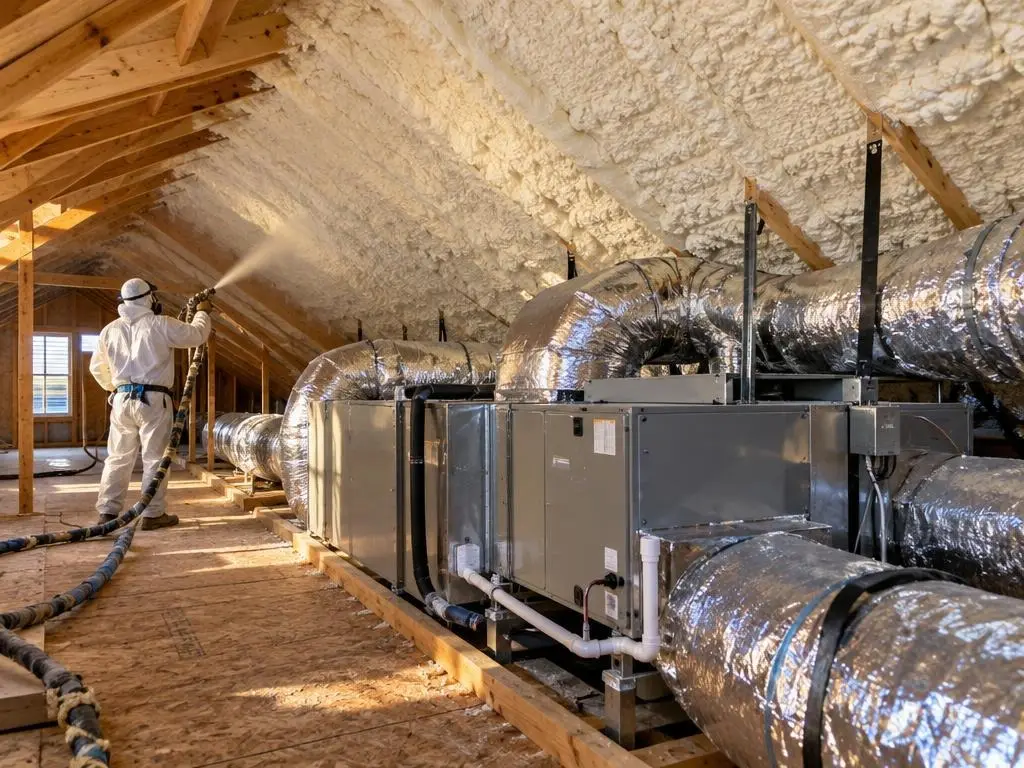
Our Services
Six services, covering everything from converting a hot attic to insulating a horse barn.
Spray Foam Insulation
Open-cell and closed-cell foam for roof decks, open walls, garage ceilings, bonus rooms and shops.
Learn more →Sealed Attic Conversion
Moving the insulation up to the roof deck with spray foam so the HVAC equipment and ducts sit inside the insulated shell.
Learn more →Attic Air Sealing & Blown-In
Sealing the leaks in the attic floor, then blowing insulation to an even, deeper depth.
Learn more →Garage, Bonus Room & Shop Insulation
Foam and sealing for garages, the bonus rooms above them, and detached shops and barns.
Learn more →New Construction & Remodel Insulation
Spray foam and other insulation for open walls in new builds, additions and remodels.
Learn more →Insulation Removal & Replacement
Vacuuming out ruined attic insulation, cleaning the attic, sealing it and putting in new.
Learn more →Get a Spray Foam Insulation Estimate in Prosper
We check the attic, the equipment and the problem rooms, then send a written price for each area.